Showing posts with label 2º ESO. Show all posts

Monday, 20 April 2020

Unit 6: Going Green. Grammar! 2/2


Hoy vamos a ver una cosa muy importante en inglés: ¡las condicionales! Y como es muy importante, la explicación va a estar en español; pero no os acostumbréis, ¿eh? 😜
Primero, tenemos que tener claro qué es una condicional, tanto en inglés como en español. Una condicional es un tipo de frase que se usa para expresar acciones o situaciones hipotéticas; es decir, no estamos hablando de la realidad, sino de lo que podría pasar si se dan unas condiciones concretas. Ejemplos:
“Si estudias mucho, aprobarás el curso”.
“Si fuera más alta, jugaría al baloncesto”.
Como vemos en los ejemplos, el uso del condicional significa que una acción depende de otra. Los condicionales se utilizan para hablar sobre situaciones reales o irreales. En general, las frases condicionales llevan la palabra “if” (literalmente, “si”, ¡pero el que no lleva acento!).
Ten en cuenta que no existe un tiempo verbal para el condicional en inglés como existe en español. A la vez, se usa el verbo auxiliar “would” para formar el condicional en inglés.
Hay cuatro tipos de condicionales, ¡pero nosotros solo vamos a ver dos! J
First Condicional/Primera condicional
Este tipo de condicional se utiliza para el futuro y en los casos en que es muy probable que la condición pasará. Se forma con If + subject + present simple + subject + future simple
If
Condition
Result
If
Present Simple
Future Simple (“will”)

Examples!
If Bill studies, he will pass the exam. / Bill will pass the exam if he studies.”
(Si Bill estudia, aprobará el examen. / Bill aprobará el examen si (él) estudia.”)
 If it doesn’t rain, we will go to the beach. / We will go to the beach if it doesn’t rain.
(Si no llueve, iremos a la playa.                    / Iremos a la playa si no llueve)
 Will you take the train if you miss the bus? / If you miss the bus, will you take the train?
(¿Cogerás el tren si pierdes el bus?                / Si (tú) pierdes el bus, ¿cogerás el tren?)
¡Ojo! Esto es como las matemáticas; puedes poner la frase con will delante o detrás de la frase con if, no altera el resultado. ¡Pero nada de mezclar las dos!
Second Conditional / Segunda Condicional
Este tipo de condicional se usa para expresar una posibilidad irreal en el presente, como un deseo o un sueño, o para una acción en el futuro no tan probable. Se forma con If + sujeto + past simple + sujeto + would + infinitive:
If
Condition
Result
If
Past Simple
Would + infinitive
Examples!
If I won the lottery, I would travel around the world. / I would travel around the world if I won the lottery.
(Si ganara la lotería, viajaría alrededor del mundo.    / (Yo) viajaría alrededor del mundo si ganara la lotería.)
If Rachel had more time, she would learn to play the guitar. / Rachel would learn to play the guitar if she had more time.
(Si Rachel tuviera más tiempo, aprendería a tocar la guitarra. /Rachel aprendería a tocar la guitarra si (ella) tuviera más tiempo.)
Would you be happy if you were to get married? / If you were to get married, would you be happy?
(¿Serías feliz si te casaras?                                             / Si te casaras, ¿serías feliz?)
And now… exercises! You download the explanation and exercises here, or go to Live Worksheets and do them online. In any case, you have until SUNDAY 26 to finish them.

Thursday, 19 March 2020

Project: Shrink your Carbon Footprint!

Hello guys!
For this weekend, we have a special project: we are going to learn about our carbon footprint, and how to reduce it. First of all, watch this video:


Link to the test.
It's pretty easy, huh? Here you have the table in .docx, in .pdf and an extra video to learn a little bit more about things we can do to shrink our footprint.

Do not forget to send the screenshot of your carbon footprint and the completed table to englishcandavera@gmail.com or upload it to the digital classroom. It will count for your mark!

See you soon! 💛

P.S. In the video, it a appears a clip with a very big "EXAMPLE" and then, nothing. It is a mistake of the video editor, sorry 🤷🏻‍♀

Liveworksheets

We are going to start working with a new tool in our classes. Please, check your emails and read this manual to learn how to use it. It's important!


Tuesday, 17 March 2020

St. Patrick's Day!


As you may know, the 17th of March Ireland celebrates its national day and Patron Saint. But, what do you really know about Saint Patrick’s Day? Let’s learn a little bit more about it!


After you watch the videos, go to this questionnaire and complete it. Don't forget to write your name, it will count for your final mark!

Happy St. Patrick's Day, everyone! 🍀🍀🍀

Monday, 16 March 2020

Unit 6: Going Green. Grammar!

Hello guys!

As you know, we're going to be studying from home for some weeks. But we need to keep listening to English! So, to make things easier, here you have a lesson on grammar, starring your teacher and your favourite big fat cat:


Your homework are explained in the video, so check it out! They will count for your final mark 😉 You can do them in a Word document and send them via email, or do them in your notebook and send a picture of them (with good quality, please!) to the same mail 😀

Remember to check the forum in the virtual classroom (your parents have an email about it!). If you have any doubts, you can post them there or write an email to englishcandavera@gmail.com

See you soon!

Saturday, 14 March 2020

Unit 6: Going Green. Vocabulary!

Here you can find a fun way to review vocabulary: flashcards! Just click on the links to do them. Have fun! ☺️

Transport 
Verbs

Stay safe, dears!

Tuesday, 3 March 2020

Unit 5: It's a crime. Grammar!


In this unit, we have seen the uses of the Past Continuous and Past Simple.

Resultado de imagen de past continuous

Here you have some exercises to practice the use of the past continuous:

Begginer: Set 1, Set 2 
Intermediate: Set 1, Set 2 
Advanced: Set 1, Set 2 

We have also seen the uses of Past Simple and Past Continuous:

 Resultado de imagen de past continuous vs past simple

And here you have the link to download the PowerPoint we have seen in class.

And some exercises to practice:

Begginer: Set 1
Intermediate: Set 1 
Advanced: Set 1

Saturday, 1 February 2020

Unit 5: It's a crime. Vocabulary!

Here you can find a fun way to review vocabulary: flashcards! Just click on the links to do them. Have fun! ☺️

Crime 
People and crime

Wednesday, 8 January 2020

Unit 4: Everyday Life. Vocabulary!

Here you can find a fun way to review vocabulary: flashcards! Just click on the links to do them. Have fun! ☺️

The weather 
The family 

Tuesday, 7 January 2020

Unit 4: Everyday Life. Grammar!

Subject/Object Questions

Before we start explaining what subject/object questions are, let’s review the difference between a subject and an object.

The subject of a sentence is the person or thing that performs the action:

We want some fruit juice.
Karen likes Fred.
Smoking causes cancer.
Daniel made a sandwich.
The earthquake damaged my house.
Jennifer lied to Sam.

The object of a sentence is the person or thing that receives the action:

We want some fruit juice.
Karen likes Fred.
Smoking causes cancer.
Daniel made a sandwich.
The earthquake damaged my house.
Jennifer lied to Sam.

Object Questions in English

Most questions in English are object questions – we want to know about the receiver of the action. These questions follow the QUASM formula: Question word – Auxiliary verb – Subject – Main verb.

For questions in the simple present, the auxiliary verbs are do and does:

What do you want to drink?
We want some fruit juice.

Who does Karen like?
Karen likes Fred.

What does smoking cause?
Smoking causes cancer.

For questions in the simple past, the auxiliary verb is did:

What did Daniel make?
Daniel made a sandwich.

What did the earthquake damage?
The earthquake damaged my house.

Who did Jennifer lie to?
Jennifer lied to Sam.

Subject Questions in English

However, sometimes we want to ask about the subject. We don’t know the person or thing who performed the action, and we want to find out.

This type of question is called a subject question, and subject questions do NOT use the auxiliary verbs do, does, and did.

How to form subject questions:
Who / What + verb in simple present or simple past + object ?


Examples of subject questions in the simple present:

Who wants some fruit juice?
We want some fruit juice.

Who likes Fred?
Karen likes Fred.

What causes cancer?
Smoking causes cancer.

Examples of subject questions in the simple past:

Who made a sandwich?
Daniel made a sandwich.

What damaged your house?
The earthquake damaged my house.

Who lied to Sam?
Jennifer lied to Sam.


When you are going to ask a question in the simple present or simple past using who or what, ask yourself,
“Am I asking about the doer of the action or the receiver of the action?”
If you’re asking about the doer/subject, then DON’T use do/does/did:

Who does want fruit juice?
Who wants fruit juice?
What did damage your house?
What damaged your house?

If you’re asking about the receiver/object, then YES – use do/does/did:

What do you want to drink?
What did the earthquake damage?

And, since practice makes perfect, here you have some exercises to work with!

Begginer: Set 1 
Intermediate: Set 1
Advanced: Set 1

Adverbs of manner

When we talk about how we do actions, we use adverbs of manner. We can also compare the actions using comparative adverbs or (not) as ... as.

I sing beautifully.
My sister swims faster than me.
My friend sail less badly than me.
I play cricket as well as my brother.

Adverbs of Manner: Definition, Rules & Examples 1

And here you have some exercises to practice it:

Begginer: Set 1
Intermediate and Advanced: Set 1 (you have to read the explanation and click on the exercises below)


Monday, 25 November 2019

Unit 3: Seeing the world. Grammar!

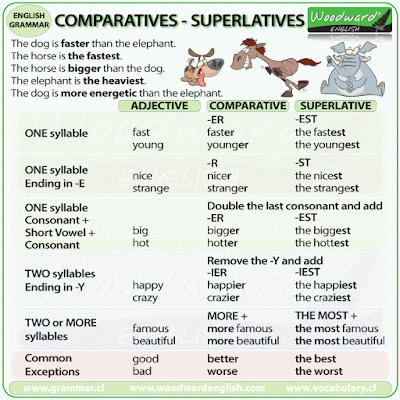
Comparison of Adjectives


In this unit, we have seen the comparison of adjectives. Here you have a brief English lesson explaining what comparatives and superlatives of adjectives are, and how to use them:


And a brief summary in this photo!

Resultado de imagen de comparatives and superlatives adjectives

And here you have some exercises to practise it!

Begginers: Set 1, Set 2
Intermediate: Set 1, Set 2
Advanced: Set 1, Set 2

Expression of sufficiency

In this unit we have seen the uses of (not) as ... as, too ... and (not) ... enough:


And here you have some exercises to practise it:

Begginers: Set 1, Set 2, Set 3 
Intermediate: Set 1, Set 2, Set 3 
Advanced: Set 1, Set 2, Set 3


Thursday, 14 November 2019

Unit 1: At School. Topic Vocabulary!

Here you can find a fun way to review vocabulary: flashcards! Just click on the links to do them. You have four different sets for each type. Have fun!

School

Activities

Sunday, 10 November 2019

Unit 2: In the news. Topic vocabulary!

Here you can find a fun way to review vocabulary: flashcards! Just click on the links to do them. You have four different sets for each type. Have fun!

Verbs

Life events

Saturday, 9 November 2019

Unit 3: Seeing the world. Topic vocabulary!

Here you can find a fun way to review vocabulary: flashcards! Just click on the links to do them. You have four different sets for each type. Have fun!

Adjectives

Geography

Friday, 8 November 2019

Unit 1: At School. Grammar!

In this unit, we have seen the Present Simple vs. Present continuous:

Resultado de imagen de present simple vs present continuous

And here you have some exercises to practice it at home. This way, you'll be more prepared for the exam! 😉

Begginers: Set 1, Set 2, Set 3
Intermediate: Set 1, Set 2, Set 3
Advanced: Set 1, Set 2, Set 3

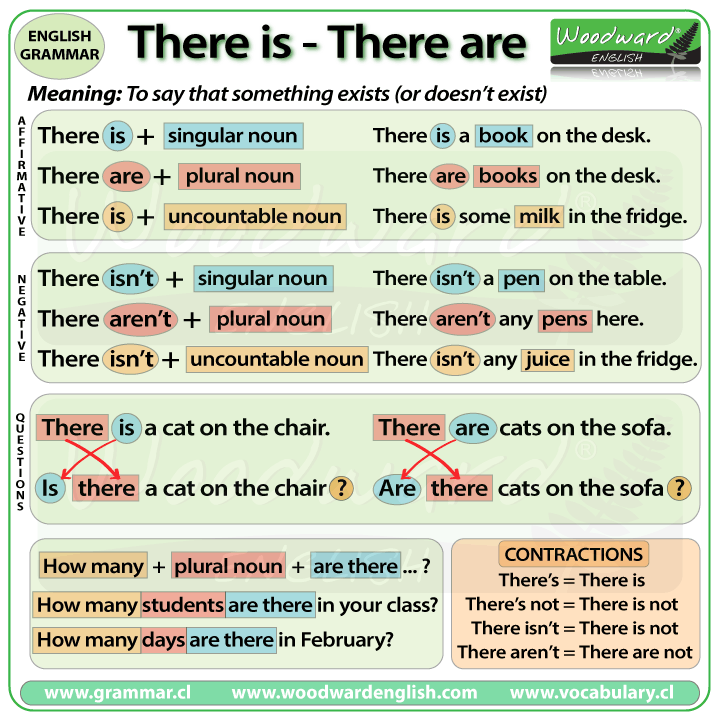
We have also seen the difference between There is and There are, and the quantifiers.

Resultado de imagen de there is vs there are

Resultado de imagen de quantifiers

And here you have some exercises to practice it!

Set 1, Set 2, Set 3, Set 4


Thursday, 7 November 2019

Unit 2: In the news. Grammar!

In this unit, we have seen the past simple.

Resultado de imagen de past simple

Here you have some flashcards to learn the irregular verbs.

And here you have some exercises to practice for the exam! 😉

Begginers: Set 1, Set 2, Set 3
Intermediate: Set 1, Set 2, Set 3
Advanced: Set 1, Set 2, Set 3

We have also seen the structure used to:
Resultado de imagen de used to

And here you have an exercise to practice it!