Showing posts with label Grammar. Show all posts

Monday, 20 April 2020

Unit 6: Going Green. Grammar! 2/2


Hoy vamos a ver una cosa muy importante en inglés: ¡las condicionales! Y como es muy importante, la explicación va a estar en español; pero no os acostumbréis, ¿eh? 😜
Primero, tenemos que tener claro qué es una condicional, tanto en inglés como en español. Una condicional es un tipo de frase que se usa para expresar acciones o situaciones hipotéticas; es decir, no estamos hablando de la realidad, sino de lo que podría pasar si se dan unas condiciones concretas. Ejemplos:
“Si estudias mucho, aprobarás el curso”.
“Si fuera más alta, jugaría al baloncesto”.
Como vemos en los ejemplos, el uso del condicional significa que una acción depende de otra. Los condicionales se utilizan para hablar sobre situaciones reales o irreales. En general, las frases condicionales llevan la palabra “if” (literalmente, “si”, ¡pero el que no lleva acento!).
Ten en cuenta que no existe un tiempo verbal para el condicional en inglés como existe en español. A la vez, se usa el verbo auxiliar “would” para formar el condicional en inglés.
Hay cuatro tipos de condicionales, ¡pero nosotros solo vamos a ver dos! J
First Condicional/Primera condicional
Este tipo de condicional se utiliza para el futuro y en los casos en que es muy probable que la condición pasará. Se forma con If + subject + present simple + subject + future simple
If
Condition
Result
If
Present Simple
Future Simple (“will”)

Examples!
If Bill studies, he will pass the exam. / Bill will pass the exam if he studies.”
(Si Bill estudia, aprobará el examen. / Bill aprobará el examen si (él) estudia.”)
 If it doesn’t rain, we will go to the beach. / We will go to the beach if it doesn’t rain.
(Si no llueve, iremos a la playa.                    / Iremos a la playa si no llueve)
 Will you take the train if you miss the bus? / If you miss the bus, will you take the train?
(¿Cogerás el tren si pierdes el bus?                / Si (tú) pierdes el bus, ¿cogerás el tren?)
¡Ojo! Esto es como las matemáticas; puedes poner la frase con will delante o detrás de la frase con if, no altera el resultado. ¡Pero nada de mezclar las dos!
Second Conditional / Segunda Condicional
Este tipo de condicional se usa para expresar una posibilidad irreal en el presente, como un deseo o un sueño, o para una acción en el futuro no tan probable. Se forma con If + sujeto + past simple + sujeto + would + infinitive:
If
Condition
Result
If
Past Simple
Would + infinitive
Examples!
If I won the lottery, I would travel around the world. / I would travel around the world if I won the lottery.
(Si ganara la lotería, viajaría alrededor del mundo.    / (Yo) viajaría alrededor del mundo si ganara la lotería.)
If Rachel had more time, she would learn to play the guitar. / Rachel would learn to play the guitar if she had more time.
(Si Rachel tuviera más tiempo, aprendería a tocar la guitarra. /Rachel aprendería a tocar la guitarra si (ella) tuviera más tiempo.)
Would you be happy if you were to get married? / If you were to get married, would you be happy?
(¿Serías feliz si te casaras?                                             / Si te casaras, ¿serías feliz?)
And now… exercises! You download the explanation and exercises here, or go to Live Worksheets and do them online. In any case, you have until SUNDAY 26 to finish them.

Thursday, 26 March 2020

Unit 6: How much? Grammar!

Today we are starting unit 6 in our books, and it is related to money and commerce. The grammar of this unit is very simple; we will be seeing the relative pronouns and the defining and non-defining relative clauses.

Relative pronouns introduce relative clauses. The most common relative pronouns are who, whom, whose, which, that. The relative pronoun we use depends on what we are referring to and the type of relative clause.

who/that       
people and sometimes pet animals
defining and non-defining
which/that
animals and things
defining and non-defining; clause referring to a whole sentence
where
places
defining and non-defining
whose
possessive meaning;
for people and animals usually; sometimes for things in formal situations
defining and non-defining
whom
people in formal styles or in writing; often with a preposition; rarely in conversation; used instead of who if who is the object
defining and non-defining
when
time
defining and non-defining
(In the examples, the relative pronoun is in brackets to show where it is not essential; the person or thing being referred to is underlined.)

We don’t know the person who donated this money.
We drove past my old school, which is celebrating its 100th anniversary this year.
He went to the school (that) my father went to.
The Kingfisher group, whose name was changed from Woolworths earlier this year, includes about 720 high street shops. Superdrug, which last week announced that it is buying Medicare, is also part of the group.
The parents (whom/who/that) we interviewed were all involved in education in some way.


Defining relative clauses


We use defining relative clauses to give essential information about someone or something – information that we need in order to understand what or who is being referred to. A defining relative clause usually comes immediately after the noun it describes.

We usually use a relative pronoun (e.g. who, that, which, whose and whom) to introduce a defining relative clause (In the examples, the relative clause is in bold, and the person or thing being referred to is underlined.):

They’re the people who want to buy our house.
Here are some cells which have been affected.
They should give the money to somebody who they think needs the treatment most.


Non-defining relative clauses


We use non-defining relative clauses to give extra information about the person or thing. It is not necessary information. We don’t need it to understand who or what is being referred to.

We always use a relative pronoun (who, which, whose or whom) to introduce a non-defining relative clause (In the examples, the relative clause is in bold, and the person or thing being referred to is underlined.)

Clare, who I work with, is doing the London marathon this year.
Doctors use the testing kit for regular screening for lung and stomach cancers, which account for 70% of cancers treated in the western world.
Alice, who has worked in Brussels and London ever since leaving Edinburgh, will be starting a teaching course in the autumn.

After reading carefully the explanation, go to liveworksheets.com and do the homework you have been assigned. You have until Monday at 10:10 to do it.

Have a nice weekend!

Monday, 16 March 2020

Unit 5: What's on? Grammar!

Hello guys;

As you know, we are now in quarantine, what means that we cannot go to the school building or do the exam we had planned for tomorrow - you're heartbroken, I know. Still, these are not holidays. We have to keep on working hard, especially taking into account that we are not going to recover this time. The lessons I'll give online will be considered done, and we won't see them in class again. We will do the exams, and that is all. So I hope that, being already in bachillerato and being almost adults, you are responsible enough to work on your own.
You can do this, guys 😉

Before we start with the grammar, let me tell you a couple of things:

-It is important that you don't lose your work and study schedules. Try to do a little bit everyday, or coming back to real life will be very hard.
-Don't live in your pajamas. Seriously, it's not a good idea.
-You need to keep listening to people talking in English. Watch TV series, or movies, or whatever, in original version. You can even play videogames in English. But keep listening to it!
-Don't lose your patience. We'll get through this. And in the meantime...

Here you have the grammar of the unit!


This is a really great explanation of the passive voice, carried out by a native speaker. Listen to it! It's a great way to practice both grammar and listening 😃

Here you have the PowerPoint that we saw in class.

And some exercises to practice! Because the exam will be waiting for you... 😈

Passive 1 (Present Simple)
Passive 2 (Past Simple) 
Passive 3 (Present Perfect)
Passive 4 (Future Simple) 
Passive 5 (Mixed Tenses)
Passive 6 (Sentences with two objects)
Passive 7 (Subordinate sentences)

You should be able to do the first five exercises. Exercises 6 and 7 are of an upper level, in cas you want to use these days to improve your performance.

Remember that the last day to hand-in your writings is tomorrow. You can hand them in in the virtual classroom, or send them via email to englishcandavera@gmail.com

Have a nice week everyone! Happy Quarantine! 


Unit 6: Going Green. Grammar!

Hello guys!

As you know, we're going to be studying from home for some weeks. But we need to keep listening to English! So, to make things easier, here you have a lesson on grammar, starring your teacher and your favourite big fat cat:


Your homework are explained in the video, so check it out! They will count for your final mark 😉 You can do them in a Word document and send them via email, or do them in your notebook and send a picture of them (with good quality, please!) to the same mail 😀

Remember to check the forum in the virtual classroom (your parents have an email about it!). If you have any doubts, you can post them there or write an email to englishcandavera@gmail.com

See you soon!

Unit 6: Amazing animals. Grammar!

Hello guys!

As you know, we're going to be studying from home for some weeks. But we need to keep listening to English! So, to make things easier, here you have a lesson on grammar, starring your teacher and your favourite big fat cat:


Your homework are explained in the video, so check it out! They will count for your final mark 😉

Remember to check the forum in the virtual classroom (your parents have an email about it!). If you have any doubts, you can post them there or write an email to englishcandavera@gmail.com

See you soon!

Tuesday, 3 March 2020

Unit 5: It's a crime. Grammar!


In this unit, we have seen the uses of the Past Continuous and Past Simple.

Resultado de imagen de past continuous

Here you have some exercises to practice the use of the past continuous:

Begginer: Set 1, Set 2 
Intermediate: Set 1, Set 2 
Advanced: Set 1, Set 2 

We have also seen the uses of Past Simple and Past Continuous:

 Resultado de imagen de past continuous vs past simple

And here you have the link to download the PowerPoint we have seen in class.

And some exercises to practice:

Begginer: Set 1
Intermediate: Set 1 
Advanced: Set 1

Wednesday, 5 February 2020

Unit 5: All about sport. Grammar!

Modal verbs

In this unit, we are seeing some modal verbs. These are: can, must and should.

Can means "saber hacer" or "poder hacer". 

Resultado de imagen de can in english"

Must in affirmative means "deber", as in an obligation or necessity. In negative (mustn't) means that something is forbidden, not allowed. 


Should is used to give advice. It means "deberías" or "no deberías" (shouldn't).


And, since practice makes perfect, here you have some exercises! 

Begginer: Set 1, Set 2, Set 3  
Intermediate: Set 1, Set 2, Set 3 
Advanced: Set 1, Set 2, Set 3 

Adverbs of manner

When we talk about how we do actions, we use adverbs of manner. We can also compare the actions using comparative adverbs or (not) as ... as.

I sing beautifully.
My sister swims faster than me.
My friend sail less badly than me.
I play cricket as well as my brother.

Adverbs of Manner: Definition, Rules & Examples 1

And here you have some exercises to practice it:

Begginer: Set 1
Intermediate and Advanced: Set 1 (you have to read the explanation and click on the exercises below)

Tuesday, 4 February 2020

Unit 4: Let's Talk. Grammar!

Here's a list of the modal verbs in English:

can                    could               may                  might
must                  shall                should              ought to


Modals are different from normal verbs:

1: They don't use an 's' for the third person singular.
2: They make questions by inversion ('she can go' becomes 'can she go?') instead of using the auxiliar.
3: They are followed directly by the infinitive of another verb (without 'to').

Probability
First, they can be used when we want to say how sure we are that something happened/is happening/will happen. We often call these 'modals of deduction' or 'speculation' or 'certainty' or 'probability'.

For example:
It's snowing, so it must be very cold outside.
I don't know where John is. He could have missed the train.
This bill can't be right. £200 for two cups of coffee!

Ability
We use 'can' and 'could' to talk about a skill or ability.

For example:
She can speak six languages.
My grandfather could play golf very well.
I can't drive.

Obligation and Advice
We can use verbs such as 'must' or 'should' to say when something is necessary or unnecessary, or to give advice.

For example:
Children must do their homework.
We have to wear a uniform at work.
You should stop smoking.

Permission
We can use verbs such as 'can', 'could' and 'may' to ask for and give permission. We also use modal verbs to say something is not allowed.

For example:
Could I leave early today, please?
You may not use the car tonight.
Can we swim in the lake?

Now, about the Perfect Modals...

Could have/couldn’t have
This denotes past ability, how you had this option in the past but now the choice no longer exists.

For example:
I could have gone to Africa when I was 16.
You could have been a rockstar, you were really good at playing the guitar.

Should have/shouldn’t have
These denote past obligation, something that you had to do in the past for the result to be favourable now. Something that was desirable, but did not happen.

For example:
He should have gone to the bank earlier, he knew he had to pay the bill today.
She shouldn’t have touched their property, that wasn’t the right thing to do.

May have/may not have/ might have/might not have.
These constructions denote past possibility, they usually describe something about which you are not quite certain.

For example:
I may have left it at home, but I’m not sure.
We might go to the party later, if you want to come.

Must have/must not have
This denotes past probability, something of which you are nearly certain but of which you are not quite sure.

For example:
I must have been really drunk last night because I don’t remember much!
She must not have heard me properly because I didn’t say that.

And, since practice makes perfect, here you have some exercises to do:

Begginer: Set 1, Set 2, Set 3 
Intermediate: Set 1, Set 2, Set 3  
Advanced: Set 1, Set 2, Set 3

Tuesday, 7 January 2020

Unit 4: Everyday Life. Grammar!

Subject/Object Questions

Before we start explaining what subject/object questions are, let’s review the difference between a subject and an object.

The subject of a sentence is the person or thing that performs the action:

We want some fruit juice.
Karen likes Fred.
Smoking causes cancer.
Daniel made a sandwich.
The earthquake damaged my house.
Jennifer lied to Sam.

The object of a sentence is the person or thing that receives the action:

We want some fruit juice.
Karen likes Fred.
Smoking causes cancer.
Daniel made a sandwich.
The earthquake damaged my house.
Jennifer lied to Sam.

Object Questions in English

Most questions in English are object questions – we want to know about the receiver of the action. These questions follow the QUASM formula: Question word – Auxiliary verb – Subject – Main verb.

For questions in the simple present, the auxiliary verbs are do and does:

What do you want to drink?
We want some fruit juice.

Who does Karen like?
Karen likes Fred.

What does smoking cause?
Smoking causes cancer.

For questions in the simple past, the auxiliary verb is did:

What did Daniel make?
Daniel made a sandwich.

What did the earthquake damage?
The earthquake damaged my house.

Who did Jennifer lie to?
Jennifer lied to Sam.

Subject Questions in English

However, sometimes we want to ask about the subject. We don’t know the person or thing who performed the action, and we want to find out.

This type of question is called a subject question, and subject questions do NOT use the auxiliary verbs do, does, and did.

How to form subject questions:
Who / What + verb in simple present or simple past + object ?


Examples of subject questions in the simple present:

Who wants some fruit juice?
We want some fruit juice.

Who likes Fred?
Karen likes Fred.

What causes cancer?
Smoking causes cancer.

Examples of subject questions in the simple past:

Who made a sandwich?
Daniel made a sandwich.

What damaged your house?
The earthquake damaged my house.

Who lied to Sam?
Jennifer lied to Sam.


When you are going to ask a question in the simple present or simple past using who or what, ask yourself,
“Am I asking about the doer of the action or the receiver of the action?”
If you’re asking about the doer/subject, then DON’T use do/does/did:

Who does want fruit juice?
Who wants fruit juice?
What did damage your house?
What damaged your house?

If you’re asking about the receiver/object, then YES – use do/does/did:

What do you want to drink?
What did the earthquake damage?

And, since practice makes perfect, here you have some exercises to work with!

Begginer: Set 1 
Intermediate: Set 1
Advanced: Set 1

Adverbs of manner

When we talk about how we do actions, we use adverbs of manner. We can also compare the actions using comparative adverbs or (not) as ... as.

I sing beautifully.
My sister swims faster than me.
My friend sail less badly than me.
I play cricket as well as my brother.

Adverbs of Manner: Definition, Rules & Examples 1

And here you have some exercises to practice it:

Begginer: Set 1
Intermediate and Advanced: Set 1 (you have to read the explanation and click on the exercises below)


Monday, 25 November 2019

Unit 3: Seeing the world. Grammar!

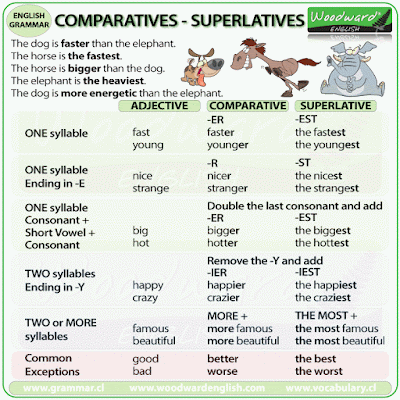
Comparison of Adjectives


In this unit, we have seen the comparison of adjectives. Here you have a brief English lesson explaining what comparatives and superlatives of adjectives are, and how to use them:


And a brief summary in this photo!

Resultado de imagen de comparatives and superlatives adjectives

And here you have some exercises to practise it!

Begginers: Set 1, Set 2
Intermediate: Set 1, Set 2
Advanced: Set 1, Set 2

Expression of sufficiency

In this unit we have seen the uses of (not) as ... as, too ... and (not) ... enough:


And here you have some exercises to practise it:

Begginers: Set 1, Set 2, Set 3 
Intermediate: Set 1, Set 2, Set 3 
Advanced: Set 1, Set 2, Set 3


Saturday, 16 November 2019

Unit 3: It's a thrill. Grammar!

In this unit, we are learning how to express future events in English. First of all, it is very important to understand the difference between time and tense. Time is an universal concept, a human perception that is divided (generally) in past, present and future. Tense, on the other hand, is a linguistic concept that is seen as a reflection of time in speaking. Nevertheless, these two concepts are not always equivalent. For example, if I say:
"My train leaves at 9.00 am tomorrow."
I am talking about tomorrow, that is, future, but using a present tense. In this case, time and tense are not equivalent.

It is important to understand this, and to learn in which ways time and tense differ in the languages we speak - since Spanish and English are not always perfect translations of each other. For example, we have an Spanish equivalent to the English be going to ("voy a"), but we do not have any equivalent to the use of present continuous with future value.

Knowing this, we can dive into the verbal tenses we'll need to pass the exam with flying colors!

Will vs. be going to


The rules are pretty simple:
uWe use will + the base form of the verb to form the Future Simple.
uWe use am, is or are + going to + the base form of the verb to form be going to.

And there you have some exercises to practice it!

Begginer: Set 1, Set 2, Set 3
Intermediate: Set 1, Set 2, Set 3
Advanced: Set 1, Set 2, Set 3

Future continuous vs. Future perfect simple


The rules are simple too:
uWe use will + be + verb + -ing to form the Future Continuous.
uWe use will + have + the past participle to form the Future Perfect Simple.

And here you have some exercises to practice it!

Begginers: Set 1, Set 2, Set 3
Intermediate: Set 1, Set 2, Set 3
Advanced: Set 1, Set 2, Set 3

Tuesday, 12 November 2019

Unit 3: Teens today. Grammar!

In this unit, we have worked with the Present Simple. Here you have a short video explaining how to do the present simple, and when to use it:

And a brief summary of the grammar:


Here you have some exercises to practice it online! This way, you'll be more prepared for the exam 😉

Begginers: Set 1, Set 2, Set 3, Set 4

Intermediate: Set 1, Set 2, Set 3, Set 4

Advanced: Set 1, Set 2, Set 3, Set 4

We have also seen the adverbs of frequency. In case you need to review it...

Resultado de imagen de adverbs of frequency

And here and here you have some exercises to practise a little bit!

Friday, 8 November 2019

Unit 1: At School. Grammar!

In this unit, we have seen the Present Simple vs. Present continuous:

Resultado de imagen de present simple vs present continuous

And here you have some exercises to practice it at home. This way, you'll be more prepared for the exam! 😉

Begginers: Set 1, Set 2, Set 3
Intermediate: Set 1, Set 2, Set 3
Advanced: Set 1, Set 2, Set 3

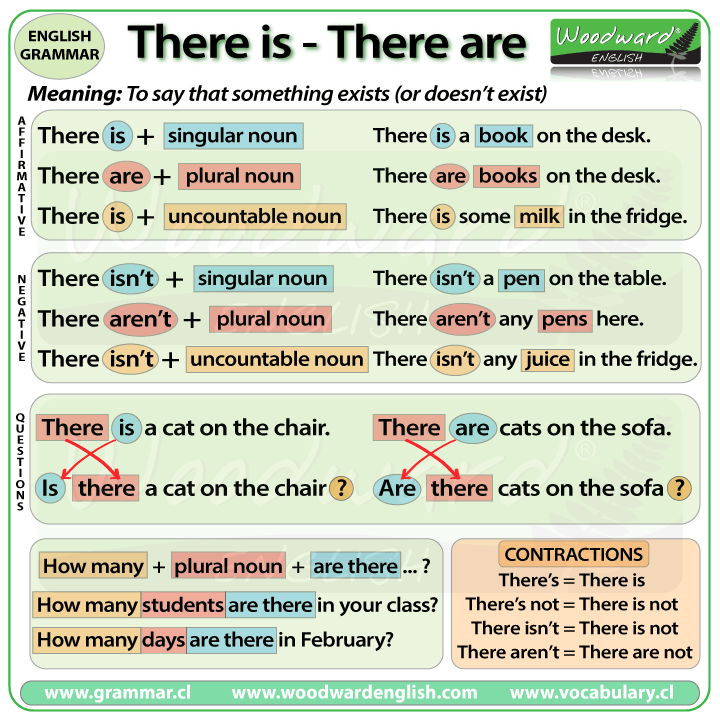
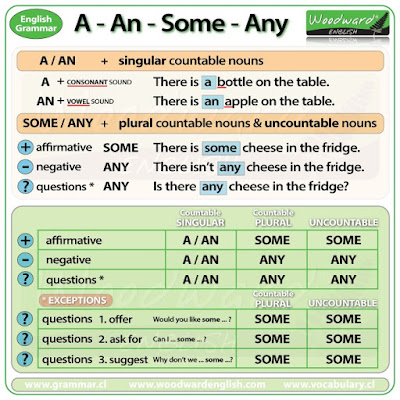
We have also seen the difference between There is and There are, and the quantifiers.

Resultado de imagen de there is vs there are

Resultado de imagen de quantifiers

And here you have some exercises to practice it!

Set 1, Set 2, Set 3, Set 4


Thursday, 7 November 2019

Unit 2: In the news. Grammar!

In this unit, we have seen the past simple.

Resultado de imagen de past simple

Here you have some flashcards to learn the irregular verbs.

And here you have some exercises to practice for the exam! 😉

Begginers: Set 1, Set 2, Set 3
Intermediate: Set 1, Set 2, Set 3
Advanced: Set 1, Set 2, Set 3

We have also seen the structure used to:
Resultado de imagen de used to

And here you have an exercise to practice it!

Saturday, 2 November 2019

Unit 2: At home. Grammar

In this unit, we have seen only one thing: the use of there is/there are with the articles and quantifiers a, an, some and any

Resultado de imagen de there is / there are

Resultado de imagen de a, an, some, any, the

And here you have some exercises to practice it:

Begginers: Set 1, Set 2, Set 3
Intermediate: Set 1, Set 2, Set 3 
Advanced: Set 1, Set 2, Set 3