Here you can find a fun way to review vocabulary: flashcards! Just click on the links to do them. Have fun! ☺️
Nouns and verbs
Adjectives
Expressions
Monday, 13 January 2020

Wednesday, 8 January 2020
Unit 4: Everyday Life. Vocabulary!
Here you can find a fun way to review vocabulary: flashcards! Just click on the links to do them. Have fun! ☺️
The weather
The family
The weather
The family
Tuesday, 7 January 2020
Unit 4: Everyday Life. Grammar!
Subject/Object Questions
Before we start explaining what subject/object questions are, let’s review the difference between a subject and an object.
The subject of a sentence is the person or thing that performs the action:
We want some fruit juice.
Karen likes Fred.
Smoking causes cancer.
Daniel made a sandwich.
The earthquake damaged my house.
Jennifer lied to Sam.
The object of a sentence is the person or thing that receives the action:
We want some fruit juice.
Karen likes Fred.
Smoking causes cancer.
Daniel made a sandwich.
The earthquake damaged my house.
Jennifer lied to Sam.
Object Questions in English
Most questions in English are object questions – we want to know about the receiver of the action. These questions follow the QUASM formula: Question word – Auxiliary verb – Subject – Main verb.
For questions in the simple present, the auxiliary verbs are do and does:
What do you want to drink?
We want some fruit juice.
Who does Karen like?
Karen likes Fred.
What does smoking cause?
Smoking causes cancer.
For questions in the simple past, the auxiliary verb is did:
What did Daniel make?
Daniel made a sandwich.
What did the earthquake damage?
The earthquake damaged my house.
Who did Jennifer lie to?
Jennifer lied to Sam.
Subject Questions in English
However, sometimes we want to ask about the subject. We don’t know the person or thing who performed the action, and we want to find out.
This type of question is called a subject question, and subject questions do NOT use the auxiliary verbs do, does, and did.
How to form subject questions:
Who / What + verb in simple present or simple past + object ?
Examples of subject questions in the simple present:
Who wants some fruit juice?
We want some fruit juice.
Who likes Fred?
Karen likes Fred.
What causes cancer?
Smoking causes cancer.
Examples of subject questions in the simple past:
Who made a sandwich?
Daniel made a sandwich.
What damaged your house?
The earthquake damaged my house.
Who lied to Sam?
Jennifer lied to Sam.
When you are going to ask a question in the simple present or simple past using who or what, ask yourself,
“Am I asking about the doer of the action or the receiver of the action?”If you’re asking about the doer/subject, then DON’T use do/does/did:
Who wants fruit juice?
What damaged your house?
If you’re asking about the receiver/object, then YES – use do/does/did:
What do you want to drink?
What did the earthquake damage?
And, since practice makes perfect, here you have some exercises to work with!
Begginer: Set 1
Intermediate: Set 1
When we talk about how we do actions, we use adverbs of manner. We can also compare the actions using comparative adverbs or (not) as ... as.
I sing beautifully.
My sister swims faster than me.
My friend sail less badly than me.
I play cricket as well as my brother.

And here you have some exercises to practice it:
Begginer: Set 1
Intermediate and Advanced: Set 1 (you have to read the explanation and click on the exercises below)
Monday, 6 January 2020
Unit 4: Great Holidays. Vocabulary!
Here you can find a fun way to review vocabulary: flashcards! Just click on the links to do them. Have fun! ☺️
Geographical features
Clothing
Geographical features
Clothing
Sunday, 5 January 2020
Unit 4: Great Holidays. Grammar!
In this unit, we work with the Present Continuous. This verbal tense is used:

Easy, right? Here you have some exercises to practice it:
Begginers: Set 1, Set 2
Intermediate: Set 1, Set 2
Advanced: Set 1, Set 2
- For things that are happening now, at the moment of speaking: "I am reading this blog."
- For things that are temporary, that will finish soon: "This month, I am leaning the present continuous."
We form the present simple putting the subject (I, you, s/he/it, we, they), the verb to be in present form (am, are, is) and the verb+ing:
Easy, right? Here you have some exercises to practice it:
Begginers: Set 1, Set 2
Intermediate: Set 1, Set 2
Advanced: Set 1, Set 2
Wednesday, 27 November 2019
Thanksgiving!
What does Thanksgiving Day celebrate?
Thanksgiving was originally a holiday to give thanks to God for the harvest. Today it is an
 opportunity to give thanks for all the good things God has given us. It is also a day to celebrate family.

When is Thanksgiving celebrated?
In the United States Thanksgiving is observed on the fourth Thursday in November. In Canada it occurs on the second Monday of October.
Who celebrates this day?
The day is widely celebrated throughout the United States and Canada.What do people do to celebrate?
The day is a national federal holiday in the United States. Most people have the day off as well as the Friday following, making a long weekend for travel and holiday.
The way most people celebrate this day is by getting together with family and having a large meal. Many people travel all over the country for large family gatherings on this day.
Many cities have large parades on Thanksgiving Day. Perhaps the largest and most famous parade is the Macy's Thanksgiving Day Parade in New York City. It is widely televised and has been running since 1924. Other cities with big parades on this day include Detroit, Philadelphia, and Chicago.
Another popular way to spend the day is watching NFL football. There are generally a number of football games on even though it is Thursday. The Detroit Lions are a traditional team that plays a game nearly every Thanksgiving.
Traditional Food
The traditional food for the Thanksgiving meal includes a turkey, cranberry sauce, potatoes, sweet potato casserole, stuffing, vegetables, and pumpkin pie.
History of Thanksgiving
Fun Facts About Thanksgiving
- Each year a live turkey is presented to the President of the United States who then "pardons" the turkey and it gets to live out its life on a farm.
- Around 46 million turkeys were eaten in the US on Thanksgiving in 2010. That's around one fifth of all the turkeys eaten for the entire year.
- Benjamin Franklin wanted the turkey to be the national bird instead of the bald eagle.
- Around 88 percent of Americans eat turkey on Thanksgiving.
- The Pilgrims sailed to America from Great Britain on a ship called the Mayflower.
- The day after Thanksgiving is called Black Friday. It is the biggest shopping day of the year.
Monday, 25 November 2019
Unit 3: Seeing the world. Grammar!
Comparison of Adjectives
In this unit, we have seen the comparison of adjectives. Here you have a brief English lesson explaining what comparatives and superlatives of adjectives are, and how to use them:
And a brief summary in this photo!
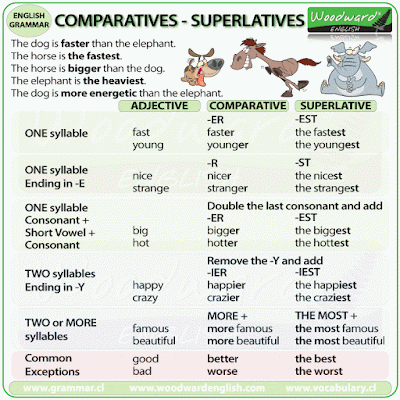
And here you have some exercises to practise it!


Subscribe to:
Posts (Atom)